 It is not the first time UnloadTab seems to have disappeared from the web. Fortunately, I had it installed on one of my computers. Here is a direct link in case you need it: http://dl.dropbox.com/u/59010825/unloadtab%40firefox.ext.xpi.
Sunday, 29 January 2012
UnloadTab - a really useful add-on for Mozilla Firefox
It is not the first time UnloadTab seems to have disappeared from the web. Fortunately, I had it installed on one of my computers. Here is a direct link in case you need it: http://dl.dropbox.com/u/59010825/unloadtab%40firefox.ext.xpi.

Thursday, 26 January 2012
Megavideo/Megaupload Killed by New Global Police: Masters Happy, Slaves to Pay
 The oligarchs (some (not me, I am too nice for that ;) ) would say: capitalist/corporate pigs) ruling the US of A do very well even without any SOPA. Without a trial, a US judge just killed a Hong Kong-based company last week and "deported" (some would say: kidnapped) non-American citizens living outside his country from (supposedly) sovereign countries to the US so that they can stand trial there and pay for their terrible crimes against American media corporations (apparently some of their customers/users (i.e. not the arrested people) were sharing content without authorization from the copyright holders (youtube anyone?)). Are you feeling like you are a character in a dystopian novel right now? I know I am. Now let us wait for SOPA to be enacted (I am sure it will... under this or different name... in a few months or after a decade... they will not give up).
Follow this link in case you are curious and want to see for yourself the results of work of the new Global Police (formerly known as FBI): http://www.megaupload.com
Below some interesting excerpts. The last one shows that many legitimate (even according to the US law) users and companies were hit by this action. I would argue, that the combined loses of those (unimportant, powerless and poor - at least when compared to the oligarchs) people are much higher than the alleged loses of the American media industry whose interest was represented by the US judicial system and the US politicians. Who is going to fight for justice for those slaves? Certainly not the system built to police them.
This proves that offshore operations can still be reached by the long arm of the U.S. law. Also, none of these folks were Americans as far as I can tell. Dotcom is German and Finnish. The lot of them will be extradited to the U.S. to be tried for what are essentially crimes against the state. Citizens of the world, beware!This, to me, is the most interesting situation since the days when the leader of Panama, Manuel Noriega, was dragged out of his bed and thrown in a Florida prison for trafficking drugs.
---
Web organisations have raised concerns about possible effects of the Megaupload case on the future of file sharing, cloud storage, and Internet commerce.[60][61][62] Various commentators including John C. Dvorak, Glenn Greenwald, and Julian Sanchez have written on the topic as well, particularly as it relates US government powers to take down a web site without a trial, even without new laws like SOPA.[63][64][65][66] In fact, the U.S. Dept of Justice was able to rely on PRO-IP, a law passed back in 2008, in order to shut down Megaupload.[67]
---
---
People who used Megaupload for personal and business storage, such as large audio and video files for family and work, have also voiced their complaints about the fact that they no longer had access to their files on the service.[68][69] Examples cited in the media included staff at public interest group Public Knowledge who used it for large files, and Android cellphone software writers who described it as "one of the best ways to distribute [software] ... There are a number of similar sites for this use, but Megaupload was always the fastest".[68]
---
Friday, 20 January 2012
Biologists on Biology and Computer Games

Today, I had an amusing discussion with two of my friends - both of them having background in life sciences (biochemistry, molecular biology, computational biology) and one of them being an avid player of computer games. The argument started when I laughed at the idea by the creators of Assassin's Creed (a computer game) that all memories of our ancestors are stored in our DNA and can be accessed by future generations. My friend started arguing that it was not impossible and recalled the fact that our DNA does change. When I pointed out that the rate of such changes is incomparably slower than the rate of acquiring new memories, the second friend came to rescue my first friend by mentioning epigenetics. Too bad my friends had to leave early as there is nothing more entertaining than a good argument when adrenaline starts to flow and both sides want to prove to the other that they are right no matter what ;). That argument is over now but there is no reason why more people could not join in and present their views here ;). What do you think guys? Is it possible that not only all your memories but also all memories of your ancestors can be stored in just one gamete (this is what my friends argued for)? In other words, is our use of the brain for storing memories (with estimated 0.15 trillion synapses in the cortex alone - now, since our DNA (including epigenetic information) supposedly stores memories of all our ancestors, do not forget to multiply this by 10 000 to 15 000 to take into account all past generations since homo sapiens sapiens appeared... and I will not mention here all future generations as we would potentially end up with a theory claiming that each individual gamete has an infinite memory storage capacity ;) ) a huge waste of energy and space? Could most of our central nervous system be replaced with just one egg or sperm cell? Think about the huge saving on hats alone! And by what means would the memories be passed onto someone's descendants after that someone had already produced their offspring? What evolutionary pressures would contribute to developing such a memory storage? And what about huge epigenetic changes caused by environmental factors other than memories ;)? Maintaining memories whilst still fulfilling the commonly recognized goal of epigenetic changes would require existence of a kind of epigenetic steganography ;). I still think the idea is ridiculous but please, do share your thoughts, I promise I will try not to laugh even if you decide to join my two friends' camp.
Thursday, 3 March 2011
Pixel Qi, Notion Ink's Adam, netbooks and my mobile computing needs
This is a follow up (just a quick update really) to my previous post (which can be read here) where I write about all the advantages of buying a netbook and replacing its LCD with a Pixel Qi display instead of buying an Adam tablet (or any other tablet currently available on the market).
On the 9th of February I ordered a new Samsung N220. It arrived just two days later. I replaced the 1GB RAM it originally had with a 2GB module (I have some spare parts lying around). After that I got rid of the preinstalled Windows 7 and Samsung's restore partition and used the whole hard drive (encrypted with AES) for Debian GNU/Linux. I quickly copied my old home directory from my Dell m1730 (a huge machine, a desktop replacement really, not usable as a mobile device) which, of course, transferred all my KDE and application settings to the new system (have been using the settings for years now, moving my home directory from one machine to another). I then quickly tuned my old settings to accommodate for much lower screen resolution and performance (my m1730 really is a monster... at least for a laptop ;) ) and, incidentally, fixed some minor problems with special keys and not being able to control the screen brightness because of some incompatibilities with GNU/Linux introduced by Samsung. After doing all that, I stopped working on the system and got back to systems biology and curing cancer ;). I have been using the netbook ever since without any problems (well, the only issue I had was the touchpad - it was annoyingly rough for my fingers to endure so I used an ordinary PST tape to make it nice and smooth... still unhappy about hardware vendors not installing a trackpoint instead of a touchpad though).
About a week ago I decided to go further with my little project and ordered a Pixel Qi display from Maker Shed. It came in less than a week which is impressive considering the fact that it was sent from the US (and I am currently based in England). I just installed the new display and I am writing this from my Samsung N220 equipped with a Pixel Qi. Everything seems to be working okay and the installation was extremely easy and took less than 20 minutes. After powering it on, the image quality looked a little weird (dark colours seemed bluish or violetish ;) ) and I detected one dead pixel (cannot find it now though so either it wasn't really a dead pixel or it is impossible to find during a normal day to day work). Also, PQ seems to have slightly weird viewing angles when compared to a regular LCD (the right side of the screen seemed a little different than the left side). I guess all this is what one should expect from a Pixel Qi display - it is worse than a regular LCD indoors but incomparably better outdoors. Besides, everything looks normal now so I guess I got accustomed and it no longer bothers me.
One thing is different - I can switch the backlight off (completely - just mapped a key for it) and still work with the netbook using ambient light (especially while having a good lamp or, better yet, sunlight around... the latter very difficult to come by in Yorkshire this part of the year ;) ). Extremely cool. Outside world, here I come ;)!
Recapitulating, I got my new mobile device in just two days... or seven, if one does not live in the US and wants a PQ display - if I had known that Adam would come with a glossy screen, ruining the effect of PQ, I wouldn't have had to wait for my new mobile device for almost two years instead of getting a netbook in two days ;/ . I paid only 205 (netbook) + 180 (PQ) = 385 GBP which is cheaper than the PQ version of Adam. It is faster than Adam, it has a keyboard (and a multi-touch touchpad for those who care), a better (matte!) PQ display, fully-fledged operating system with lots of applications (Debian has more than 20 000 packages) and my favourite desktop environment (KDE) with all the effects, cubes and whatnot ;). It is equipped with a huge (comparing to Adam or iPad) storage device - currently 250GB but could be easily extended as it is just a regular SATA drive - and the whole thing is encrypted with AES so I do not have to worry about my data in case I lose the netbook (or if it gets stolen) - there is no true mobile computing without keeping one's data secure while on the go and yet I know of no mainstream tablet which comes with this (essential - especially in case of mobile devices!) feature. Why? Maybe tablets and smartphones are targeted at people who want to play low-quality games (comparing to the latest products available for PC) and don't even care about someone getting their credentials for Facebook or e-mail account when the device is lost/stolen? Seriously, how can one even check their e-mail (not to mention accessing their bank account or buying something with their credit card or paypal) without having the phone/tablet fully encrypted?! Enough about security though. Did I mention my mobile device has 2GB of RAM ;)? The only feature still missing when you compare it to a tablet is the touch screen - which isn't a priority for me - yet still I plan to install it in the future. If I decided to go for one of the currently available DIY touch screen kits (resistive, no multi-touch), it would cost me about 40-60 GBP which brings the sum total to about 425-445 GBP which, I believe, would still be cheaper than Notion Ink's Adam (if you include the cost of importing it into the UK).
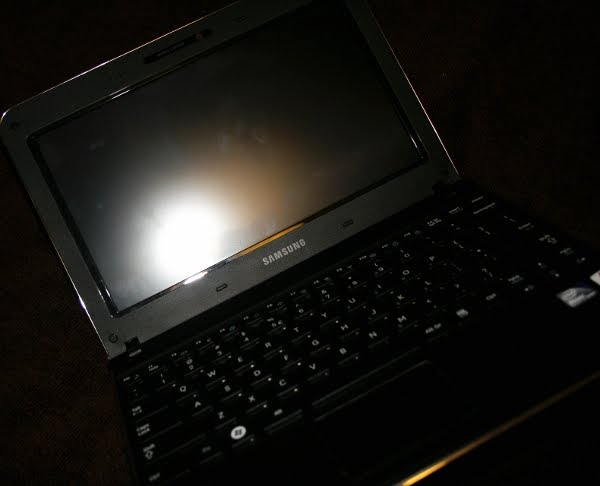
Here are a few photographs (thanks Gabi :) ) - of my new machine with the PQ installed:


Believe it or not but in the above three photographs the display backlight is off (not just darkened but completely off) and the photos were taken in a dark room so the only source of light was Gabi's camera flash - and yet one can perfectly see what's on the screen. The last image shows the netbook suspended (hence nothing on the screen).
Thursday, 17 February 2011
My pseudohaiku #1

Feelings.
The words I write... just a mere shadow of what I feel.
Uttered would become a travesty.
Thursday, 10 February 2011
Goodbye Adam
Well, it is final. I am disappointed with Notion Ink's Adam... and I am not talking about the numerous business-side problems everyone can read about, but about their decision to cover the Pixel Qi display with a reflecting glass and thus turning it into another high-tech mirror (still much better than the iPad but I am not interested in half measures).
Since I still need a mobile device, I decided to stop waiting for a miracle and bought myself a netbook yesterday (hope to get it tomorrow). I decided to go with the Samsung n210/n220[plus] (they are all almost identical... really). With the right battery (these models are sold with either a 3-cell battery or a 6-cell battery which comes in two versions - 4400 and 5900 mAh) the battery life should be around 8-10 hours (Samsung claims 13.5h but I wouldn't trust them here ;)).
After it arrives and I decide I like it, I intend to replace its dipslay, which is a decent matte (Yes! Finally someone made a good design decision! Thank you!) LCD, with a Pixel Qi. This way I will be able to use the netbook even in direct sunlight and its battery life is expected to go further up by 20-25%!.
Another modification I think about is adding a touch-sensing layer in front of the Pixel Qi (matte - not the glossy abomination used in Adam!).
When everything is complete, I will have a device with the following characteristics:
- much faster than iPad (even the old Atom N270s are faster than A4)
- almost e-ink image quality in direct sunlight (but with the responsiveness of LCD (e.g. video playback etc.))
- a decent LCD indoors
- 10-12 hours actual battery life
- a multi-touch touchpad and display
- a decent keyboard (no Adam or iPad can compete here)
- a full Debian GNU/Linux with KDE 4 - the best OS out there (the netbook comes with Microsoft Windows 7 so I could have a dual-boot but I don't need another gaming machine)
The only thing the above lacks is a trackpoint instead of a touchpad. Trackpoints are so much better. Invaluable to a touch-typist and they even allow people to play computer games which are impossible to play with a touchpad (e.g. FPSs). Still, Alienware (including the smallest model for mobile use) and other gaming laptops all ship with touchpads - how crazy is that?!
To wrap up, here are links to youtube videos watching which should make everyone understand why, after waiting for almost two years, I decided to give up on Adam and go for a pure Pixel Qi solution:
- Adam vs. Kindle (e-ink) - after watching this, ask yourself if you would like to work with Adam in the sun for a few hours
- Kindle vs. pure Pixel Qi (vs. transflective Toshiba for US$2000) - now compare Pixel Qi here with Adam in the previous video
- Pixel Qi vs. iPad - not really relevant to this topic so posting it here just for the fun factor - "mobility according to Apple" or "be mobile but stay in your basement" (if you are wondering, iPad is turned on ;) ) !
Saturday, 13 March 2010
A Comparison of Qt and Java for Large-Scale, Industrial-Strength GUI Development

Here is an interesting paper for you to read: http://turing.iimas.unam.mx/~elena/PDI-Lic/qt-vs-java-whitepaper.pdf.
Just skimmed through it. The good thing is that it is based on research (numbers do not lie ;) ) and not just some anecdotal "evidence". My thoughts? If you are a computer scientist who really knows their stuff and can choose between C++ and Java for your next project - choose C++. If you are an entrepreneur or a manager - hire the best programmers and choose C++... or Python... or Python & C++... and Qt ;)... or use OpenLaszlo... or ZK... or whatever ;)...
BTW, if you are a Java (or C#) programmer interested in mastering C++ & Qt then here is a nice book for you, which, apart from introducing Qt, contains a chapter (well, an appendix really) entitled "Introduction to C++ for Java and C# Programmers":
C++ GUI Programming with Qt 4 (2nd Edition)
The best thing is that the book has been published under the Open Publication License so it can be also legally downloaded from the Internet.
But returning to the paper... if you don't feel like reading the whole then here are some interesting excerpts:
--
In conclusion: both research and practice contradict the claim that Java programmers achieve a higher programmer-efficiency than C++ programmers.
Both independent academic research and industrial experience demonstrate that the hype favouring Java is mostly unjustified, and that the C++/Qt combination is superior.
Research shows that in practice, garbage collection and other Java features, do not have a major influence on the programmer-efficiency. One of the classic software estimation models, Barry Boehm’s CoCoMo1 predicts the cost and schedule of a software project using cost drivers which take into account variables like the general experience of a programmers, the experience with the programming language in question, the targeted reliability of the program, etc. Boehm writes that the amount of effort per source statement was highly independent of the language level. Other research, for example, A method of programming measurement and estimation by C.E. Walston and C.P. Felix of IBM, points in the same direction.
This is also backed up by our own experience: if programmers can choose their favorite programming language (which is usually the one they have most experience of), programmers with the same level of experience (measured for example, in years of programming experience in general) achieve about the same programmer-efficiency.
Another interesting aspect that we noted (but which is not yet supported by any formal research) is that less experienced developers seem to achieve somewhat better results with Java, medium-experienced developers achieve about the same results with both programming languages, and experienced developers achieve better results with C++.
Again, Prechelt provides useful data. The amount of data he provides is huge, but he arrives at the conclusion that "a Java program must be expected to run at least 1.22 times as long as a C/C++ program". Note that he says at least; the average runtime of Java programs is even longer. Our own experience shows that Java programs tend to run about 2-3 times as long than their equivalent C/C++ programs for the same task. Not surprisingly, Java loses even more ground when the tasks are CPU-bound.
When it comes to programs with a graphical user interface, the increased latency of Java programs is worse than the runtime performance hit. Usability studies show that users do not care about whether a long running task takes, say, two or three minutes, but they do care when a program does not show an immediate reaction to their interaction, for example when they press a button. These studies show that the limit of what a user accepts before they consider a program to be "unresponsive" can be as little as 0.7 seconds.
Prechtelt provides figures which state that on average (...) and with a confidence of 80%, the Java programs consume at least 32 MB (or 297%) more memory than the C/C++ programs (...). In addition to the higher memory requirements, the garbage collection process itself requires processing power which is consequently not available to the actual application functionality, leading to slower overall runtimes.
When dealing with external programs and devices, for example, during I/O or when interacting with a database, it is usually desirable to close the file or database connection as soon as it is no longer required. Using C++’s destructors, this happens as soon as the programmer calls delete. In Java, closing may not occur until the next garbage collecting sweep, which at best may tie up resources unnecessarily, and at worst risks the open resources ending up in an inconsistent state.
The fact that Java programs keep memory blocks around longer than is strictly necessary is especially problematic for embedded devices where memory is often at a premium.
To sum up this discussion, we have found C++ to provide much better runtime- and memory-efficiency than Java, while having comparable programmer-efficiency.
Subscribe to:
Comments (Atom)
Popular Posts
-
I have stumbled upon yet another atheist propaganda clumsily disguised as a balanced article whose author pretends to be objective and f...
-
It is not the first time UnloadTab seems to have disappeared from the web. Fortunately, I had it installed on one of my computers. Here i...
-
The oligarchs (some (not me, I am too nice for that ;) ) would say: capitalist/corporate pigs) ruling the US of A do very well even withou...
-
Well, it is final. I am disappointed with Notion Ink's Adam... and I am not talking about the numerous business-side problems everyo...
-
 This is a follow up (just a quick update really) to my previous post (which can be read here ) where I write about all the advantages of buy...
 -
 Remains of a tiny fraction of ~2,000,000 victims massacred by an atheist regime led by Pol Pot. As most (if not all) of the Athei...
 -
 Whether 'tis nobler in the mind to suffer The slings and arrows of outrageous fortune, Or to take arms against a sea of trouble...
 -
What started as a light-hearted comment to one of my friend's Google+ posts about the structure of the snowflake ultimately got me thin...
-
How to do anything you want without breaking the law? One of the top media industry lobbyists inadvertently shares his secret with us in th...
-
I do not understand what is the source of the myth , which seems to be so widespread in the West, that Poland and Poles were or are particu...


