Monday, 20 February 2012

Who will save the forgotten music

I was just listening to Janacek's sinfonietta when my thoughts drifted away from one of my top secret projects and, in my mind, I saw a vision of all the pieces of classical music ever created, one by one sliding into oblivion and dying.  The process is slow but it is happening even now, as I am Swyping these words on my Android phone.  The most well-known masterpieces are still with us, still far from being forgotten, but most of classical music is not being played anymore.  It is all over again the vicious circle of marketing probing customers' demand, selecting musical pieces for which  the measured demand is highest (i.e. the most popular (or, in other words, the least forgotten) music is being selected), and feeding this selection back to the customers.  The music which has not been selected is effectively being slowly erased from our collective memory (and less and less is being selected with each iteration of this cycle as yesterday's less demanded becomes today's least demanded since the previous least demanded have been filtered out from the today's selection list).  How many of you had ever listened to Janacek before Haruki Murakami's 1Q84 appeared?
What could be done to save dying music (and bring all those forgotten pieces back to us)?  I think I have found a solution which would be quite easy to implement (certainly easier than bringing down capitalism with its monetary system and switching humanity to the resource-based economy (which, I hope, will happen someday)).  Hiring a good director and a full orchestra to prepare and then perform even just one piece is incredibly expensive but importing a score into a computer programme and charging a computer with the task of performing such music is very cheap and quick nowadays (I am sure most of us have used a midi player at least once in our life).  Of course settling for just that is nothing new and would not be enough as computers are notorious for their mechanical and dull music performance.  However, if we go one step further and throw machine learning methods into this then we should be able to teach our computers how to give unique and inspired musical performances.  We have all the needed elements.  Machine learning methods have become quite powerful and the data - I.e. recordings of the best and worst performances together with their complete musical scores - is there.  Each performance is different which means not 100% faithful to the score.  It is these fluctuations what makes one performance unforgettable and another just dull.  Finding patterns in these fluctuations and being able to generalise these patterns and apply them to any score is, from my perspective, just another exercise in supervised learning.  Seems like an interesting machine learning project with possible commercial applications (think about economical impact on production of classical music considering the huge savings on live performers and production time).  Too bad there are only 24 hours in a day and I cannot realise all those ideas which appear in my mind every day.  Maybe I should start publishing them in hope that someone will be inspired and see them through ;).  Let us hope the music will be saved.  It would be so nice to be able to browse through and listen to all those now forgotten masterpieces (most of them never recorded) somewhere on the Web.
Apropos inspiration.  I just realised that the chain of events which led to my reading the novel which resulted in my listening to the sinfonietta which in turn made my thoughts wandering and ended up  in my writing this blog post, all that started with my dear friend Yoshi who I should probably thank for this moment of contemplation.  It is good to have friends who can inspire us, without them our life would not be full.

Sunday, 29 January 2012

UnloadTab - a really useful add-on for Mozilla Firefox

It is not the first time UnloadTab seems to have disappeared from the web. Fortunately, I had it installed on one of my computers. Here is a direct link in case you need it: http://dl.dropbox.com/u/59010825/unloadtab%40firefox.ext.xpi.

Thursday, 26 January 2012

Megavideo/Megaupload Killed by New Global Police: Masters Happy, Slaves to Pay

The oligarchs (some (not me, I am too nice for that ;) ) would say: capitalist/corporate pigs) ruling the US of A do very well even without any SOPA. Without a trial, a US judge just killed a Hong Kong-based company last week and "deported" (some would say: kidnapped) non-American citizens living outside his country from (supposedly) sovereign countries to the US so that they can stand trial there and pay for their terrible crimes against American media corporations (apparently some of their customers/users (i.e. not the arrested people) were sharing content without authorization from the copyright holders (youtube anyone?)). Are you feeling like you are a character in a dystopian novel right now? I know I am. Now let us wait for SOPA to be enacted (I am sure it will... under this or different name... in a few months or after a decade... they will not give up).

Follow this link in case you are curious and want to see for yourself the results of work of the new Global Police (formerly known as FBI): http://www.megaupload.com

Below some interesting excerpts. The last one shows that many legitimate (even according to the US law) users and companies were hit by this action. I would argue, that the combined loses of those (unimportant, powerless and poor - at least when compared to the oligarchs) people are much higher than the alleged loses of the American media industry whose interest was represented by the US judicial system and the US politicians. Who is going to fight for justice for those slaves? Certainly not the system built to police them.

This proves that offshore operations can still be reached by the long arm of the U.S. law. Also, none of these folks were Americans as far as I can tell. Dotcom is German and Finnish. The lot of them will be extradited to the U.S. to be tried for what are essentially crimes against the state. Citizens of the world, beware!This, to me, is the most interesting situation since the days when the leader of Panama, Manuel Noriega, was dragged out of his bed and thrown in a Florida prison for trafficking drugs.
---

Web organisations have raised concerns about possible effects of the Megaupload case on the future of file sharing, cloud storage, and Internet commerce.[60][61][62] Various commentators including John C. Dvorak, Glenn Greenwald, and Julian Sanchez have written on the topic as well, particularly as it relates US government powers to take down a web site without a trial, even without new laws like SOPA.[63][64][65][66] In fact, the U.S. Dept of Justice was able to rely on PRO-IP, a law passed back in 2008, in order to shut down Megaupload.[67]
---

---
People who used Megaupload for personal and business storage, such as large audio and video files for family and work, have also voiced their complaints about the fact that they no longer had access to their files on the service.[68][69] Examples cited in the media included staff at public interest group Public Knowledge who used it for large files, and Android cellphone software writers who described it as "one of the best ways to distribute [software] ... There are a number of similar sites for this use, but Megaupload was always the fastest".[68]
---

Friday, 20 January 2012

Biologists on Biology and Computer Games

Today, I had an amusing discussion with two of my friends - both of them having background in life sciences (biochemistry, molecular biology, computational biology) and one of them being an avid player of computer games. The argument started when I laughed at the idea by the creators of Assassin's Creed (a computer game) that all memories of our ancestors are stored in our DNA and can be accessed by future generations. My friend started arguing that it was not impossible and recalled the fact that our DNA does change. When I pointed out that the rate of such changes is incomparably slower than the rate of acquiring new memories, the second friend came to rescue my first friend by mentioning epigenetics. Too bad my friends had to leave early as there is nothing more entertaining than a good argument when adrenaline starts to flow and both sides want to prove to the other that they are right no matter what ;). That argument is over now but there is no reason why more people could not join in and present their views here ;). What do you think guys? Is it possible that not only all your memories but also all memories of your ancestors can be stored in just one gamete (this is what my friends argued for)? In other words, is our use of the brain for storing memories (with estimated 0.15 trillion synapses in the cortex alone - now, since our DNA (including epigenetic information) supposedly stores memories of all our ancestors, do not forget to multiply this by 10 000 to 15 000 to take into account all past generations since homo sapiens sapiens appeared... and I will not mention here all future generations as we would potentially end up with a theory claiming that each individual gamete has an infinite memory storage capacity ;) ) a huge waste of energy and space? Could most of our central nervous system be replaced with just one egg or sperm cell? Think about the huge saving on hats alone! And by what means would the memories be passed onto someone's descendants after that someone had already produced their offspring? What evolutionary pressures would contribute to developing such a memory storage? And what about huge epigenetic changes caused by environmental factors other than memories ;)? Maintaining memories whilst still fulfilling the commonly recognized goal of epigenetic changes would require existence of a kind of epigenetic steganography ;). I still think the idea is ridiculous but please, do share your thoughts, I promise I will try not to laugh even if you decide to join my two friends' camp.

Thursday, 3 March 2011

Pixel Qi, Notion Ink's Adam, netbooks and my mobile computing needs

This is a follow up (just a quick update really) to my previous post (which can be read here) where I write about all the advantages of buying a netbook and replacing its LCD with a Pixel Qi display instead of buying an Adam tablet (or any other tablet currently available on the market).

On the 9th of February I ordered a new Samsung N220. It arrived just two days later. I replaced the 1GB RAM it originally had with a 2GB module (I have some spare parts lying around). After that I got rid of the preinstalled Windows 7 and Samsung's restore partition and used the whole hard drive (encrypted with AES) for Debian GNU/Linux. I quickly copied my old home directory from my Dell m1730 (a huge machine, a desktop replacement really, not usable as a mobile device) which, of course, transferred all my KDE and application settings to the new system (have been using the settings for years now, moving my home directory from one machine to another). I then quickly tuned my old settings to accommodate for much lower screen resolution and performance (my m1730 really is a monster... at least for a laptop ;) ) and, incidentally, fixed some minor problems with special keys and not being able to control the screen brightness because of some incompatibilities with GNU/Linux introduced by Samsung. After doing all that, I stopped working on the system and got back to systems biology and curing cancer ;). I have been using the netbook ever since without any problems (well, the only issue I had was the touchpad - it was annoyingly rough for my fingers to endure so I used an ordinary PST tape to make it nice and smooth... still unhappy about hardware vendors not installing a trackpoint instead of a touchpad though).

About a week ago I decided to go further with my little project and ordered a Pixel Qi display from Maker Shed. It came in less than a week which is impressive considering the fact that it was sent from the US (and I am currently based in England). I just installed the new display and I am writing this from my Samsung N220 equipped with a Pixel Qi. Everything seems to be working okay and the installation was extremely easy and took less than 20 minutes. After powering it on, the image quality looked a little weird (dark colours seemed bluish or violetish ;) ) and I detected one dead pixel (cannot find it now though so either it wasn't really a dead pixel or it is impossible to find during a normal day to day work). Also, PQ seems to have slightly weird viewing angles when compared to a regular LCD (the right side of the screen seemed a little different than the left side). I guess all this is what one should expect from a Pixel Qi display - it is worse than a regular LCD indoors but incomparably better outdoors. Besides, everything looks normal now so I guess I got accustomed and it no longer bothers me.

One thing is different - I can switch the backlight off (completely - just mapped a key for it) and still work with the netbook using ambient light (especially while having a good lamp or, better yet, sunlight around... the latter very difficult to come by in Yorkshire this part of the year ;) ). Extremely cool. Outside world, here I come ;)!

Recapitulating, I got my new mobile device in just two days... or seven, if one does not live in the US and wants a PQ display - if I had known that Adam would come with a glossy screen, ruining the effect of PQ, I wouldn't have had to wait for my new mobile device for almost two years instead of getting a netbook in two days ;/ . I paid only 205 (netbook) + 180 (PQ) = 385 GBP which is cheaper than the PQ version of Adam. It is faster than Adam, it has a keyboard (and a multi-touch touchpad for those who care), a better (matte!) PQ display, fully-fledged operating system with lots of applications (Debian has more than 20 000 packages) and my favourite desktop environment (KDE) with all the effects, cubes and whatnot ;). It is equipped with a huge (comparing to Adam or iPad) storage device - currently 250GB but could be easily extended as it is just a regular SATA drive - and the whole thing is encrypted with AES so I do not have to worry about my data in case I lose the netbook (or if it gets stolen) - there is no true mobile computing without keeping one's data secure while on the go and yet I know of no mainstream tablet which comes with this (essential - especially in case of mobile devices!) feature. Why? Maybe tablets and smartphones are targeted at people who want to play low-quality games (comparing to the latest products available for PC) and don't even care about someone getting their credentials for Facebook or e-mail account when the device is lost/stolen? Seriously, how can one even check their e-mail (not to mention accessing their bank account or buying something with their credit card or paypal) without having the phone/tablet fully encrypted?! Enough about security though. Did I mention my mobile device has 2GB of RAM ;)? The only feature still missing when you compare it to a tablet is the touch screen - which isn't a priority for me - yet still I plan to install it in the future. If I decided to go for one of the currently available DIY touch screen kits (resistive, no multi-touch), it would cost me about 40-60 GBP which brings the sum total to about 425-445 GBP which, I believe, would still be cheaper than Notion Ink's Adam (if you include the cost of importing it into the UK).

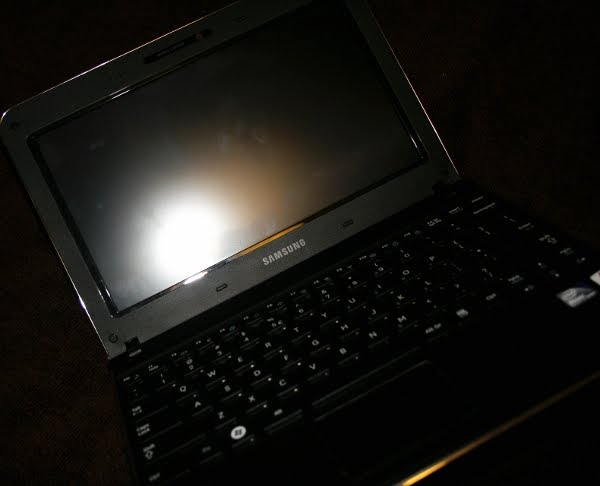
Here are a few photographs (thanks Gabi :) ) - of my new machine with the PQ installed:

Believe it or not but in the above three photographs the display backlight is off (not just darkened but completely off) and the photos were taken in a dark room so the only source of light was Gabi's camera flash - and yet one can perfectly see what's on the screen. The last image shows the netbook suspended (hence nothing on the screen).

Thursday, 17 February 2011

My pseudohaiku #1


Feelings.
The words I write... just a mere shadow of what I feel.
Uttered would become a travesty.

Thursday, 10 February 2011

Goodbye Adam

Well, it is final. I am disappointed with Notion Ink's Adam... and I am not talking about the numerous business-side problems everyone can read about, but about their decision to cover the Pixel Qi display with a reflecting glass and thus turning it into another high-tech mirror (still much better than the iPad but I am not interested in half measures).
Since I still need a mobile device, I decided to stop waiting for a miracle and bought myself a netbook yesterday (hope to get it tomorrow). I decided to go with the Samsung n210/n220[plus] (they are all almost identical... really). With the right battery (these models are sold with either a 3-cell battery or a 6-cell battery which comes in two versions - 4400 and 5900 mAh) the battery life should be around 8-10 hours (Samsung claims 13.5h but I wouldn't trust them here ;)).

After it arrives and I decide I like it, I intend to replace its dipslay, which is a decent matte (Yes! Finally someone made a good design decision! Thank you!) LCD, with a Pixel Qi. This way I will be able to use the netbook even in direct sunlight and its battery life is expected to go further up by 20-25%!.

Another modification I think about is adding a touch-sensing layer in front of the Pixel Qi (matte - not the glossy abomination used in Adam!).

When everything is complete, I will have a device with the following characteristics:
  • much faster than iPad (even the old Atom N270s are faster than A4)
  • almost e-ink image quality in direct sunlight (but with the responsiveness of LCD (e.g. video playback etc.))
  • a decent LCD indoors
  • 10-12 hours actual battery life
  • a multi-touch touchpad and display
  • a decent keyboard (no Adam or iPad can compete here)
  • a full Debian GNU/Linux with KDE 4 - the best OS out there (the netbook comes with Microsoft Windows 7 so I could have a dual-boot but I don't need another gaming machine)
The only thing the above lacks is a trackpoint instead of a touchpad. Trackpoints are so much better. Invaluable to a touch-typist and they even allow people to play computer games which are impossible to play with a touchpad (e.g. FPSs). Still, Alienware (including the smallest model for mobile use) and other gaming laptops all ship with touchpads - how crazy is that?!

To wrap up, here are links to youtube videos watching which should make everyone understand why, after waiting for almost two years, I decided to give up on Adam and go for a pure Pixel Qi solution:
  • Adam vs. Kindle (e-ink) - after watching this, ask yourself if you would like to work with Adam in the sun for a few hours
  • Pixel Qi vs. iPad - not really relevant to this topic so posting it here just for the fun factor - "mobility according to Apple" or "be mobile but stay in your basement" (if you are wondering, iPad is turned on ;) ) !

Popular Posts